

I begin from an assumption: reality is not fragmented but unified. What humanity often divides into disciplines, anthropology, economics, politics, identity, and theology, may in truth be different languages attempting to describe a single governing reality. I call this unity the Kingdom.
If this assumption holds, then the Kingdom is not merely a religious concept but the grammar of existence itself: a governing authority that does not remain distant from creation but integrates itself into the manifested realm we call "Earth." The Kingdom is not an escape from reality; it is the hidden order within reality.
The revelation of the Kingdom of God becomes, therefore, the lens through which we approach the mystery of Elohim, the triune expression of the Divine.
Yet immediately, we encounter a paradox.
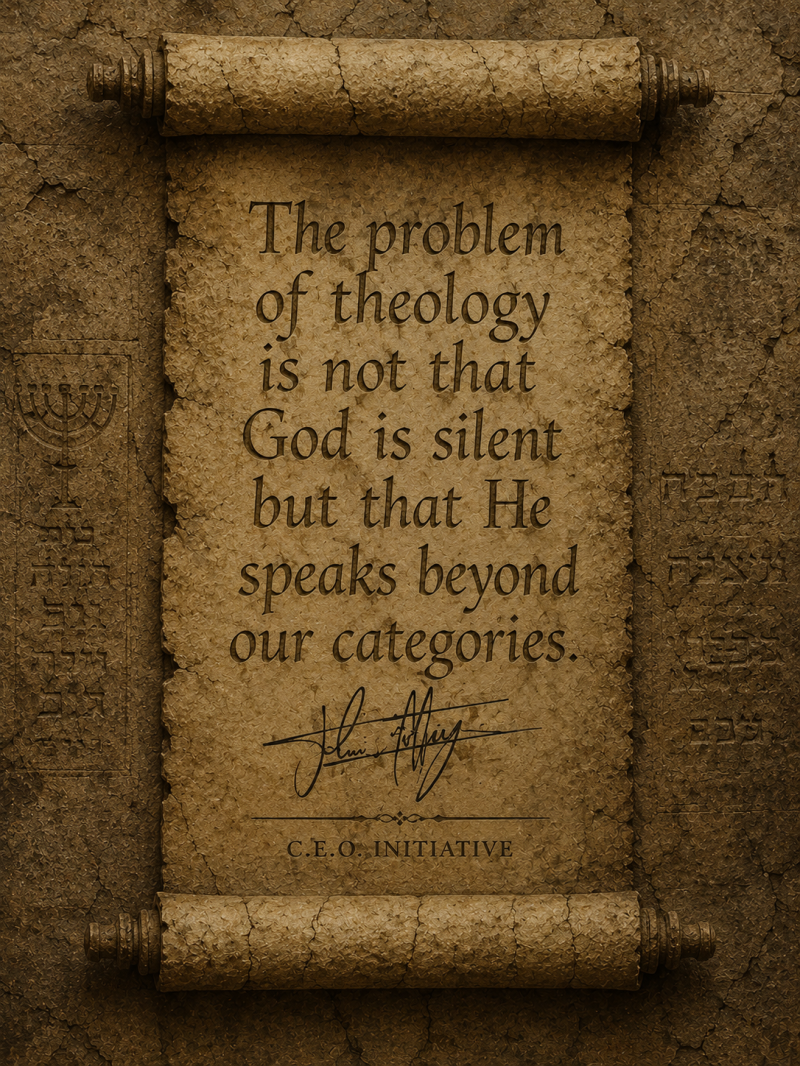
We speak of God to understand Him, yet the first truth about God is that He exceeds understanding. We define to know, yet God refuses containment within definitions. Theology stands on uneasy ground: it must speak, even while knowing that what it speaks cannot be fully said.
The term "Trinity," or what I prefer to call the "Triune God," is not a solution to the mystery of God but an admission of it. It is a language offered to human limitations, not a boundary placed upon divine reality. What we possess is not comprehension but permission: the privilege to perceive only what has been revealed.
Truth exists because Elohim exists. Yet our grasp of truth remains partial, provisional, and reverent.
God cannot be explained; He can only be experienced through His expressions.
This tension is not new. In the ancient writings, Yahweh commanded Moshe to instruct the people not to form images of Him, for no form had been shown to them. The prohibition against images was not merely moral; it was theological. Humanity was warned against reducing the Infinite to familiarity, against mistaking representation for revelation.
God withheld form so that humanity would not worship certainty instead of mystery.
When I speak of Israel, I do not refer to a modern nation-state or a single ethnicity. I speak of a people known fully only to Yahweh, a diverse assembly shaped by calling rather than bloodline. Throughout history, the Divine revealed Himself according to purpose, not preference; according to redemption, not geography.
After humanity’s fall, the trajectory of divine action appears consistent: the redemption of Adam, humanity itself. The story of Scripture becomes less about religious systems and more about divine pursuit. God continually makes Himself available to His creation, even as creation struggles to perceive Him.
To understand the Triune God, we must begin by accepting that definitive understanding is impossible. We see only through revelation preserved in writings, history, memory, and encounter. Across time, a singular testimony emerges: one Lord, one authority, one sovereign King who made Himself known among humanity so that people surrounded by competing powers and “gods” might recognise the One who truly rules.
He became God to a people so they could discover that He is the Creator of all peoples.
The progression of revelation from Abraham to the Hebrew people and beyond shows not a changing God but a God revealing Himself progressively according to human capacity. Revelation unfolds in seasons. Humanity grows into understanding; God does not grow into being.
Here we meet another antinomy:
God is one, yet revealed in multiplicity.
Unchanging, yet dynamically present.
Hidden, yet continually manifest.
What, then, is the Trinity?
It is not three gods.
It is not a mathematical puzzle.
It is not a philosophical equation awaiting resolution.
It is Yahweh’s divine multiplicity expressed through action.
All divine revelation is action based. God is known by what He does among humanity. He reveals Himself as Creator, as Father, and as Spirit, not as separate beings but as purposeful expressions of the same sovereign reality.
From the beginning, Yahweh revealed Himself as the Creator of Adam and humanity. Across generations, He appeared through encounters that humanity named according to experience: God, King, the Angel of the Lord, Deliverer, Judge, and Shepherd. These titles did not define Him; they described humanity’s meeting with Him.
At the appointed time for redemption, the Divine entered human history as the Son, flesh and blood, transcendent yet touchable, eternal yet born within time. In this expression, humanity encountered Him as Savior, Healer, Redeemer, and Son of God.
And when the promise required continuation rather than departure, He came again as Spirit Advocate, Comforter, and Helper present not beside humanity but within it.
Three persona visitations, yet one sovereign king.
At the baptism of Jesus Christ, Scripture records a moment of profound mystery: the Father speaks, the Son stands in the water, and the Spirit descends like a dove. The scene does not divide God; it reveals divine relational expression. Unity manifests as plurality without surrendering sovereignty.
The Kingdom of God is ruled by a King, not by competing rulers. Out of His majesty, He engages creation according to purpose and will. His manifestations cannot be fully explained because He fills all things and exists beyond all things simultaneously.
Here lies the oxymoron at the heart of faith:
God is knowable yet incomprehensible.
Present yet uncontainable.
One is yet to be expressed in many ways.
Therefore, the Trinity remains a sacred tension rather than a settled definition. Human language approaches but never captures divine reality. We interpret according to our capacity, while divine multiplicity exceeds every interpretation.
There are not three gods. There is one sovereign King whose expressions meet humanity wherever redemption requires.
The Kingdom of Elohim is ruled by the King and only by the King.
And perhaps this is what our generation must rediscover: faith is not the elimination of mystery but the courage to live within it. The Kingdom does not remove questions; it gives them direction. It does not simplify God; it reveals that ultimate reality is deeper than explanation and closer than breath.
The Divine does not demand that humanity understand Him completely.
He invites humanity to encounter Him continually.
Add comment
Comments
One of my favourite articles you have written so far!